Making of194 commits · 218 days · one page
Making of
How the parts of this site were built, the versions they went through, and the measurement that settled each one.
Most of what was built for this site lost. Forty-one voices, forty-five shapes, twenty-six transitions, nine beams and four lenses. They are all on this page, and they all still run.
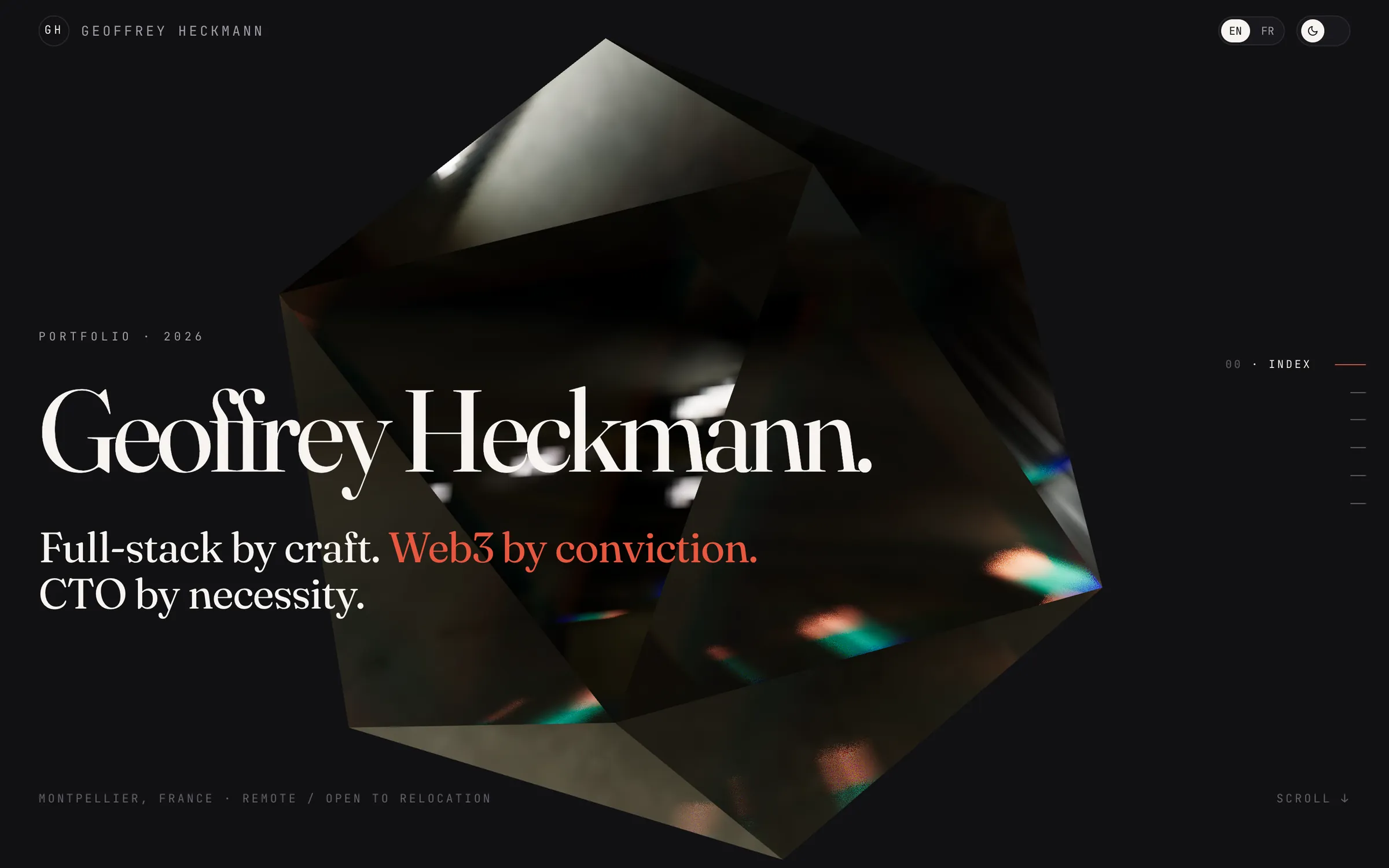
The hero, version by version
Version 1 of 5
78e5a83
feat: design tokens, layout shell, i18n, canvas shell, prism v0, deploy prep
Scroll to advance. Each frame is a commit.
Chapter 01The opening39 commits in this chapter
Press, cut, strike
Evolution3
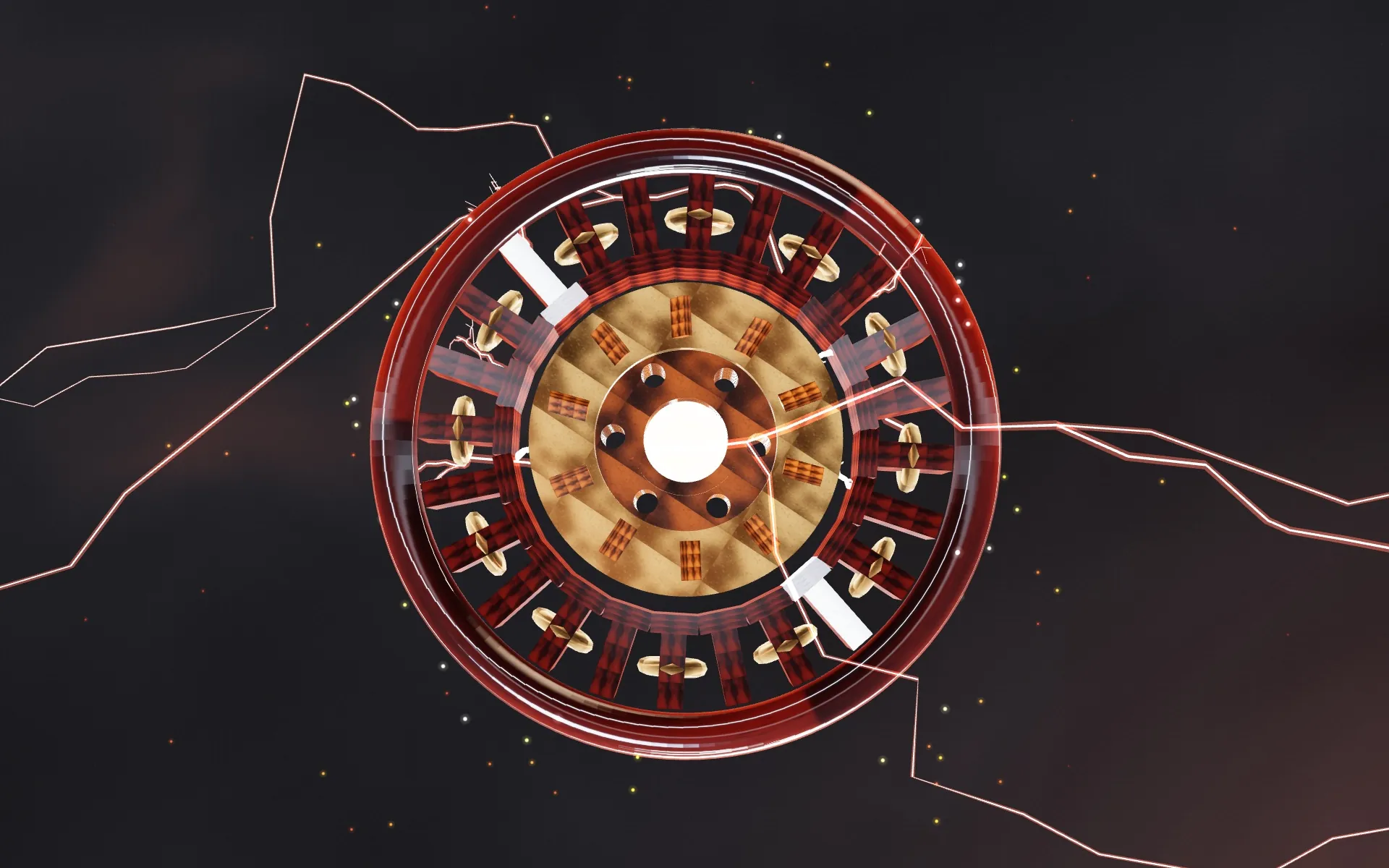
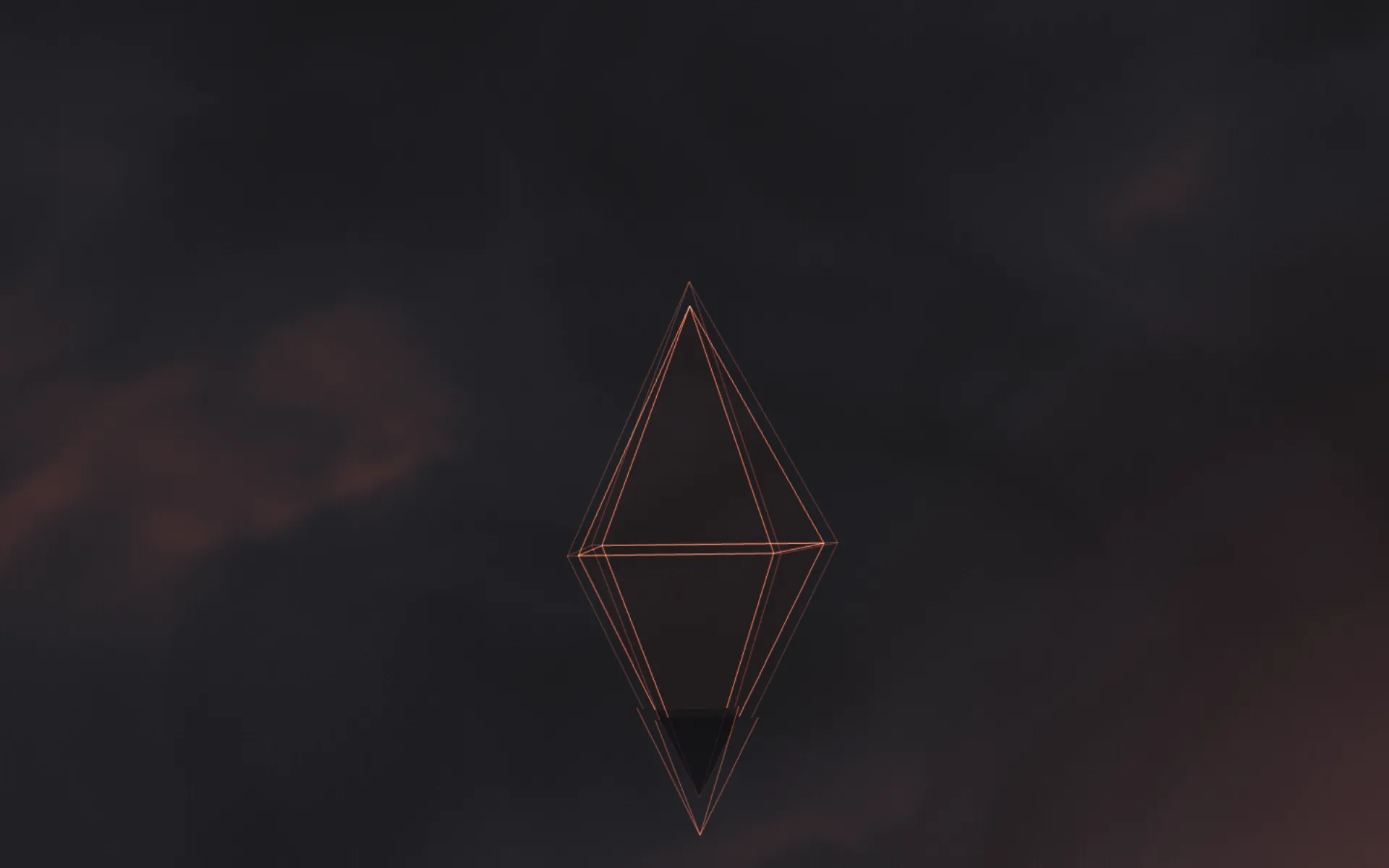
d52897dfeat: new introAfterFirst rotor, first breaker trip49f5a45feat(hero): end the intro on a breaker trip, with synthesised soundIn motion
c29870ffeat(home): the work ring shows the work, and the page holds togetherThe rotor's thirty teeth arrive only when you press. Browsers hold audio back until a gesture, and the assembly is the densest run of sound in the intro, so on a clock it built itself in silence. The press now starts the build, and the same finger carries into the spool-up.
When the breaker trips, the screen goes to a black of 0.999. A fully opaque layer lets the compositor stop painting the page beneath it, and the bill arrived on the frame the light came back: 866 ms, longer than the 260 ms flicker it was there to show.
The name strikes as a neon tube on the room's failing supply. It catches with the strip light, drops out with it, and holds when it holds. The overlay is a Web Animation, so a dropped frame stretches the beat and the beat survives.
Chapter 02The catalogue26 commits in this chapter
A ring with mass
Evolution4

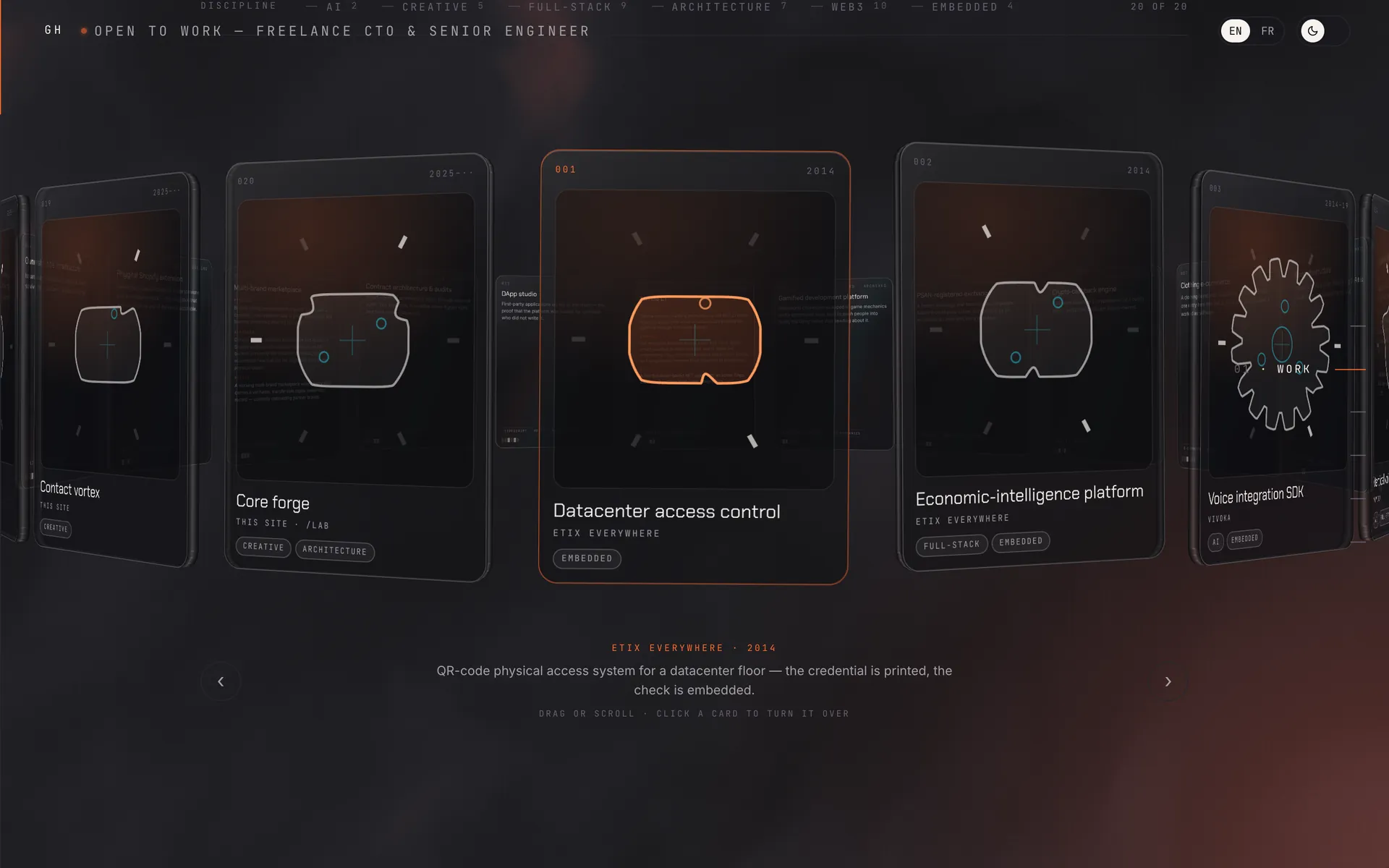
Compare two versions
- 0129 Apr 2026
- 026 Aug 2026
- 0323 Nov 2026
1c0eea7feat(work): replace the case studies with the catalogueAfterThe ring shows the workc29870ffeat(home): the work ring shows the work, and the page holds togetherIn motion
c29870ffeat(home): the work ring shows the work, and the page holds togetherThe first ring rounded every drag to a whole card and eased between cards on a 720 ms transition. However hard you threw it, it moved one card and stopped. Position is now a continuous number, thrown by hand, slowed by friction and landed by a critically damped spring.
Twenty field lines hold it in place. The eye sits in the ring's own plane, so straight radial lines all fell onto one line of the screen and shipped as a single bright bar. Each line now bows into a plane of its own, turned by a multiple of the golden angle.
Arcs follow the spin with no floor. Spin it hard for long enough and the supply goes white, every line fires and every card turns over. The supply's voice is a noise band chopped into grains and rung through a comb a few milliseconds long. It is one of eleven.
Chapter 03The head14 commits in this chapter
A face with no skeleton
Evolution3
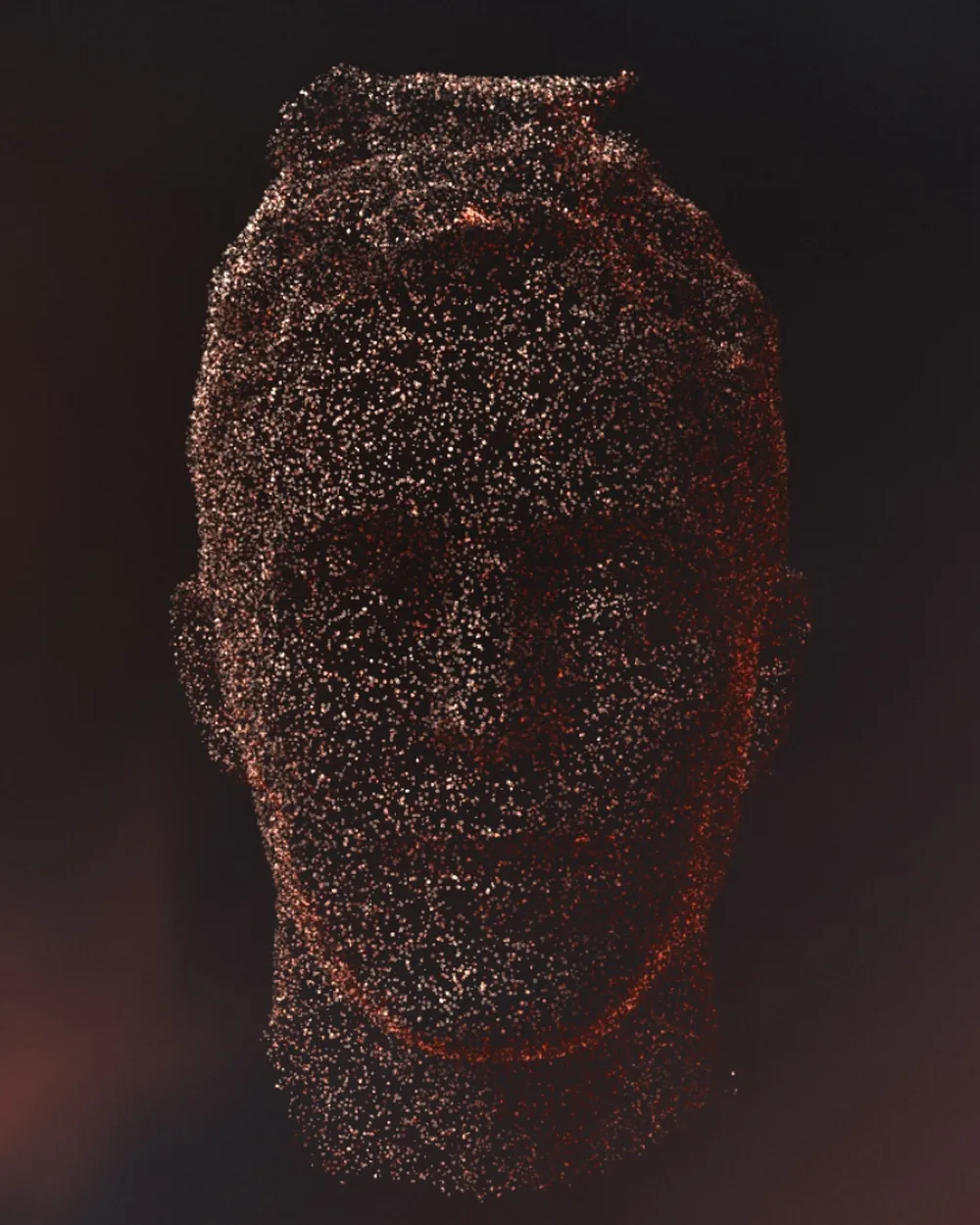
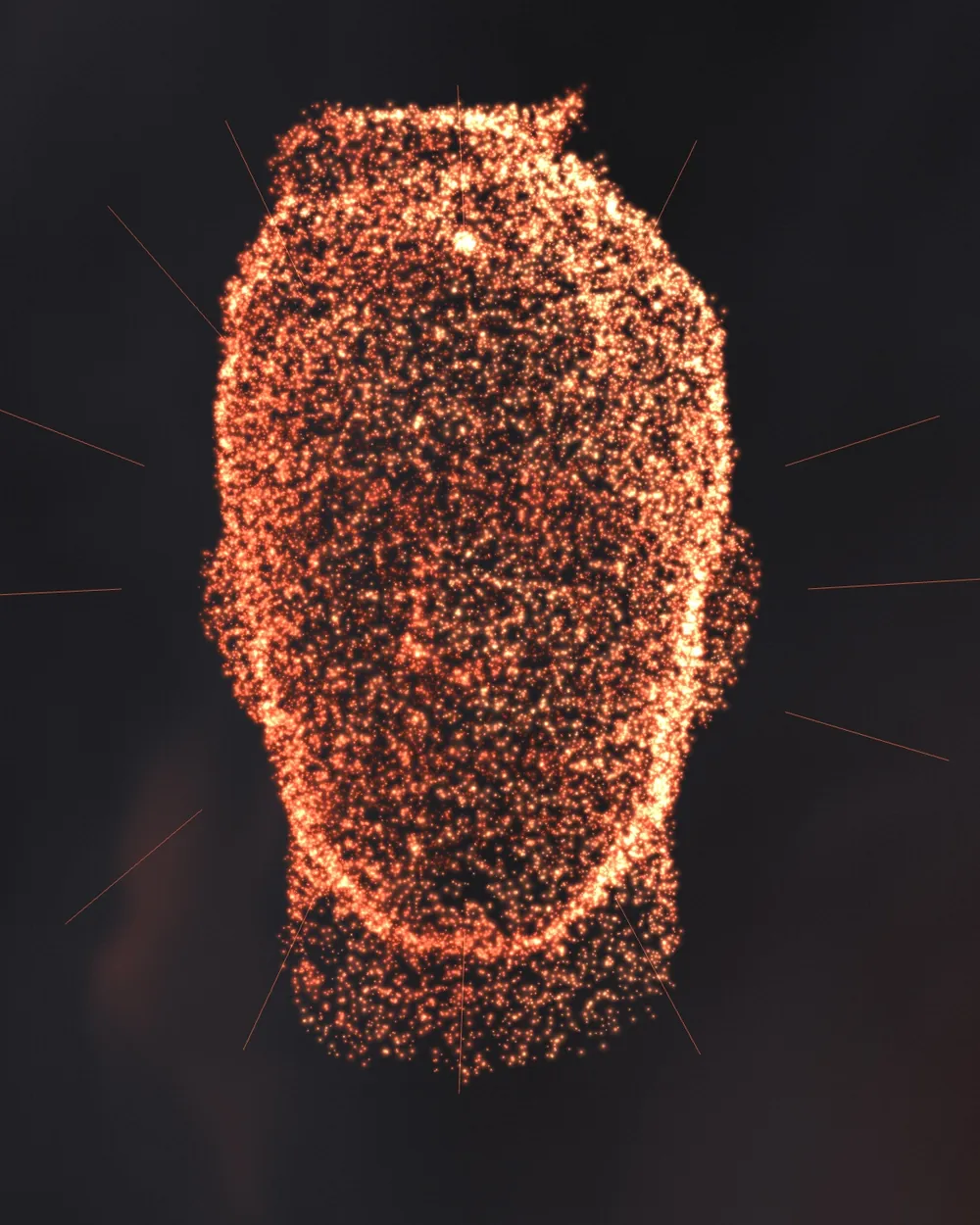
dd28b75feat(about): rebuild section around an interactive 3D head with orbital data labels and stats panelAfterMoved to the hero, inked dark4243006feat(hero): fold About into the hero as a head that assembles from the introIn motion
c29870ffeat(home): the work ring shows the work, and the page holds togetherThe head is 55,000 points on a desktop and 26,000 on a phone, sampled from a scan of 20,711 vertices. The scan holds positions and nothing else, so the rig is synthesised: gaussian regions around anchor points move the jaw, the lids, the brows and the mouth. It blinks irregularly, and sometimes twice.
The first cursor wake summed impulses in the vertex shader and could draw a ring and nothing else. Position and velocity now live in half-float textures, integrated by a fragment shader, so a flick throws points and they coast. Curl noise swirls the disturbed material without bunching it up.
The push follows the cursor's travel and is never normalised, so a slow drag pushes less than a flick. Anything derived from the head's own geometry made the deformation hug the face.
Chapter 04Experience22 commits in this chapter
Two torches and a helix
Evolution3


d5bb238feat: replace prism with generative ink field, add tagline split-reveal, magnetic cursor, animated section labels, and WebGL heat-haze on case study cardsAfterTwo torches weld it8d8a9e5feat(experience): weld the helix into existenceIn motion
c29870ffeat(home): the work ring shows the work, and the page holds togetherThe timeline is a double helix welded as you scroll. Both torches are parented to the camera, so they stay fixed on screen and only the weld point travels. The arc's intensity is scroll velocity with no floor. Stop scrolling and it goes out, light and sound together.
The beam is seven billboarded quads at staggered widths, chosen against nine other constructions. One was a shaded cylinder, and a cylinder has a silhouette. Every falloff is gaussian, except a hard white filament on the innermost layer.
The section is read more than it is scrolled. At rest it draws at 30 frames a second and nothing is simulated or uploaded. The weld's voice starts at 4.2 kHz with no low end. It is one of sixteen.
Chapter 05Skills12 commits in this chapter
A pool of 104 points
Evolution4
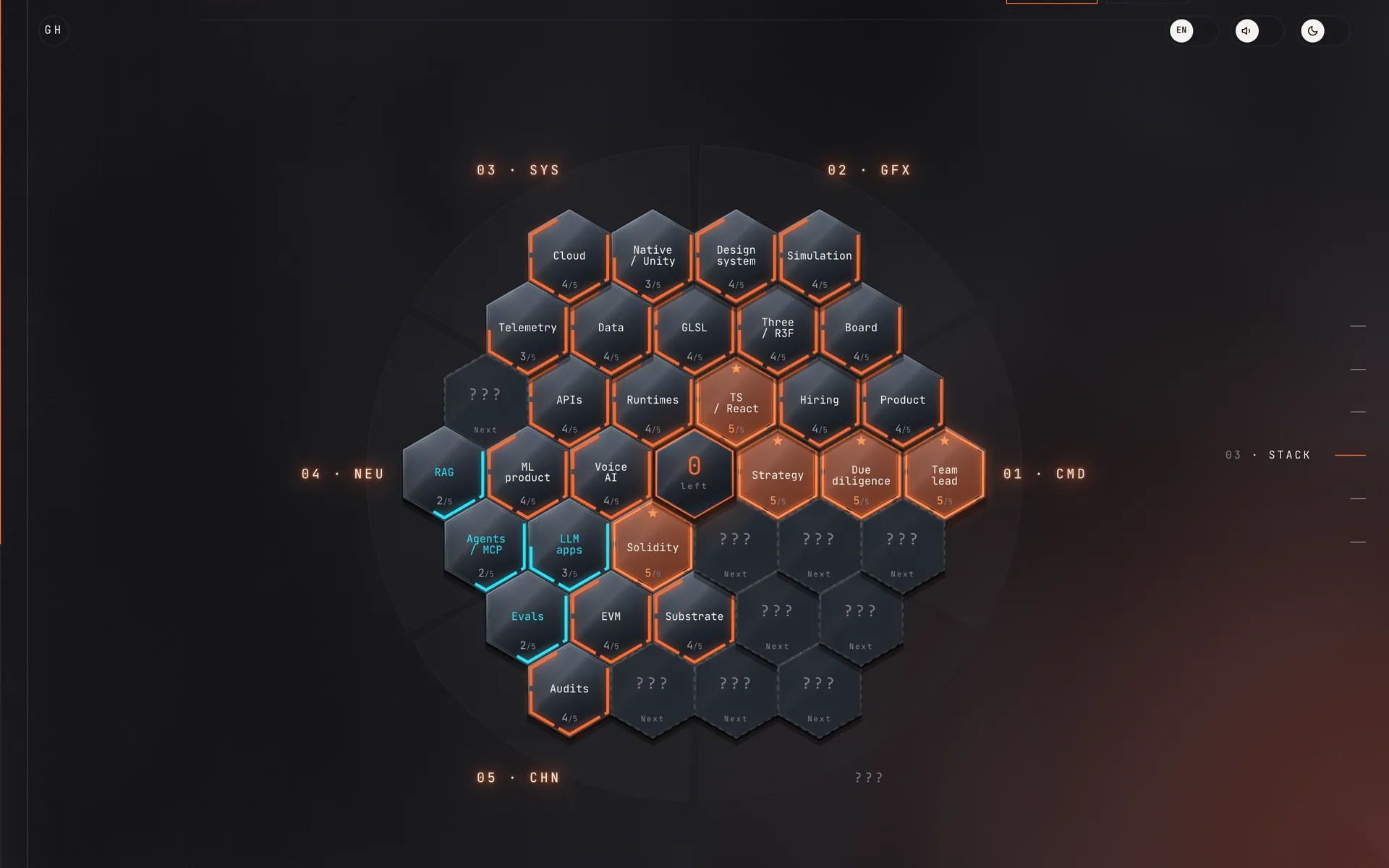
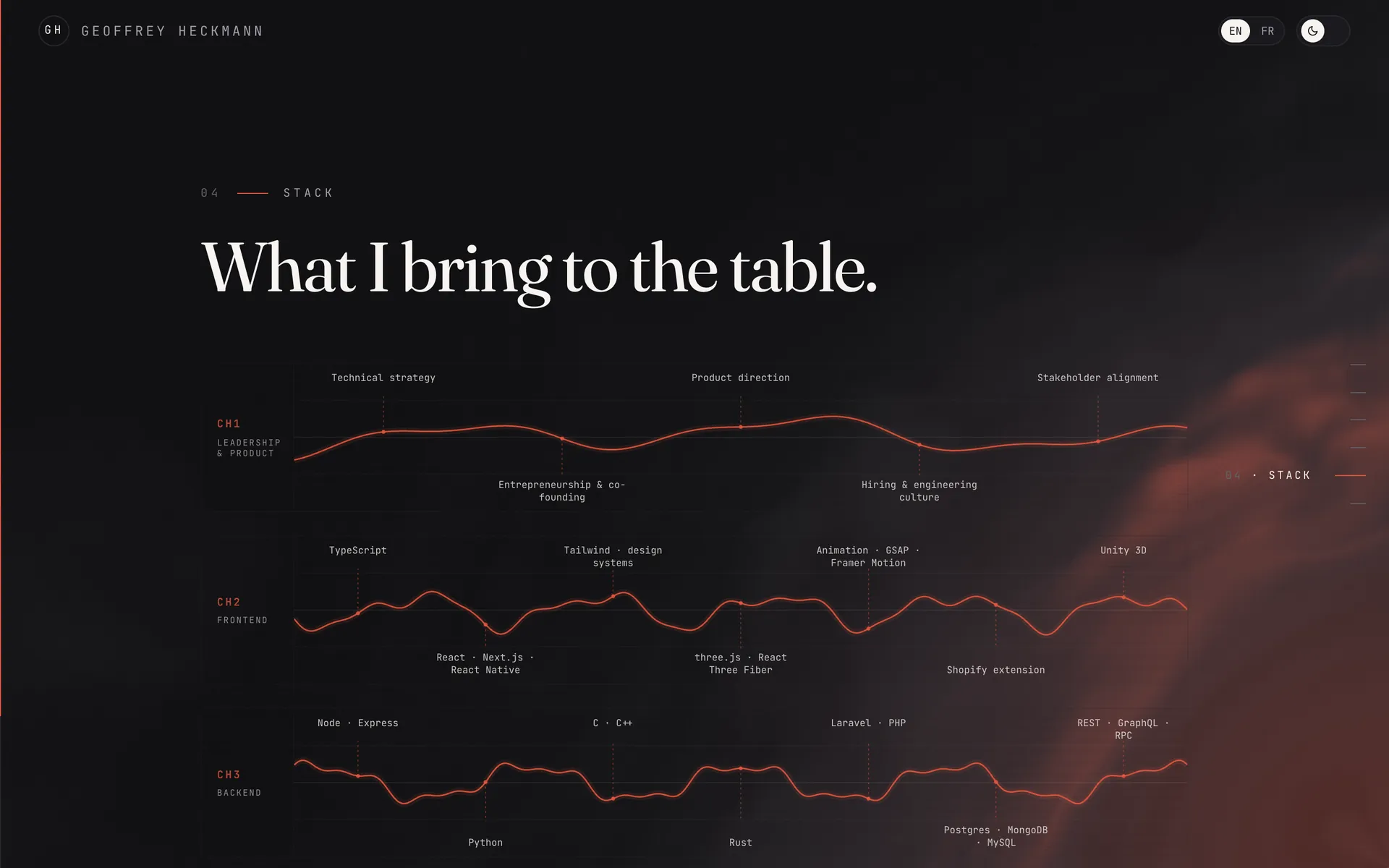
Compare two versions
- 0122 Apr 2026
- 0223 Apr 2026
- 0323 Nov 2026
59403a9feat: add skills oscillogramsAfterThe board, every point spentc29870ffeat(home): the work ring shows the work, and the page holds togetherIn motion
c29870ffeat(home): the work ring shows the work, and the page holds togetherSection 03 started as an oscillogram. The waveform carried no information, the data sat in two-pixel dots, and the one thing worth saying, shipped or still being built, was a legend at the bottom. Twenty-six replacements were built in three rounds.
A hex field won. One cell per capability, one wedge per discipline, a core in the middle. A cell opens only once a neighbour in its own discipline holds a point, so the field grows outward as it is spent, and no cell takes more than the capability is worth.
The cascade spends a point every 24 ms, and each one went through a tree of five hundred nodes. A cell is now its own memoised component, and its glow is one dashed copy of the lit run instead of a filter on each of the 104 bars.
Chapter 06Method17 commits in this chapter
Ten cells and a sentry
Evolution3
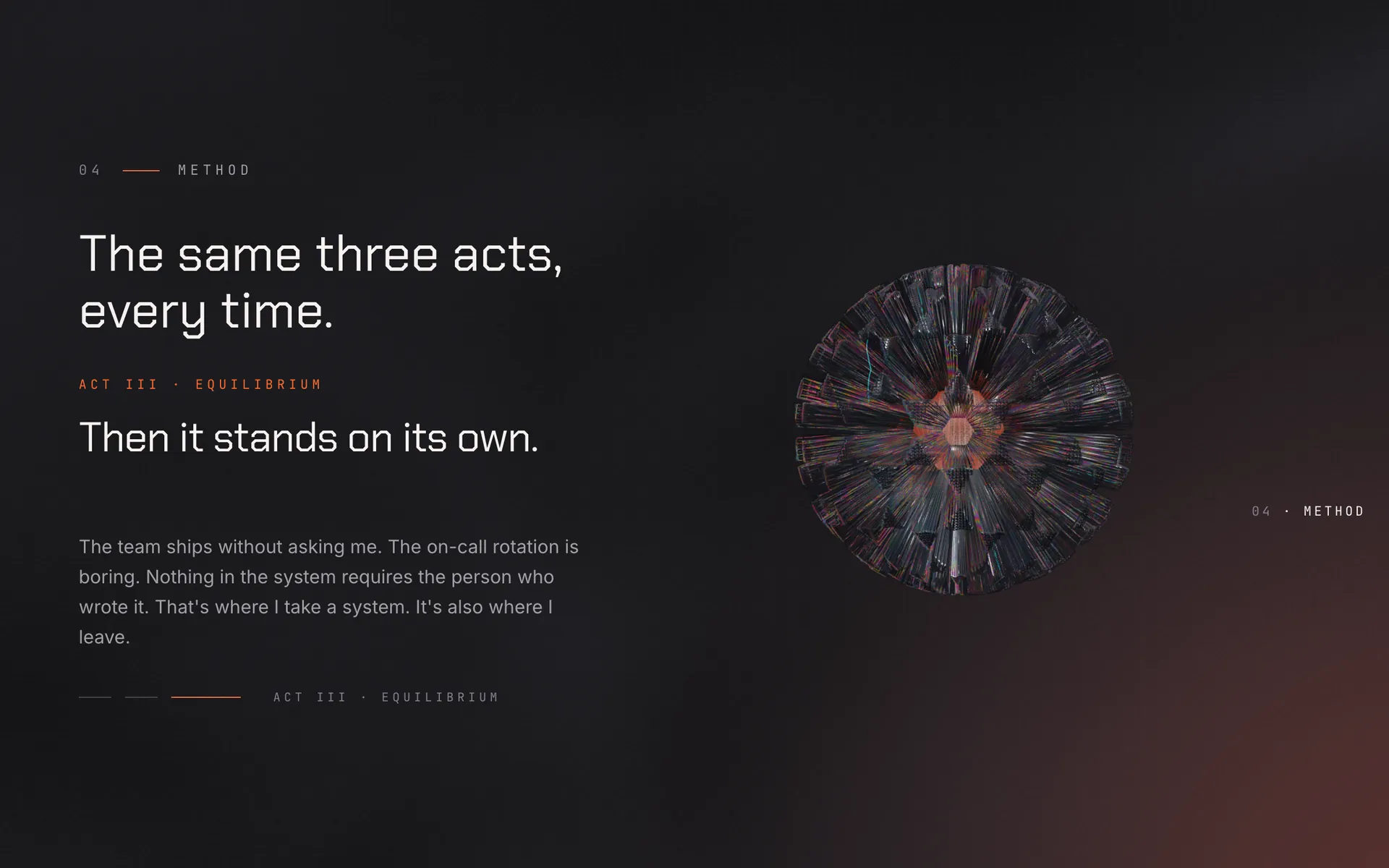

c1b17dcchore: change light theme helix colorsAfterAct three: the lattice corec29870ffeat(home): the work ring shows the work, and the page holds togetherIn motion
c29870ffeat(home): the work ring shows the work, and the page holds togetherThe method section resolves onto a wired lattice, chosen on a bench of forty-seven shapes and twenty-eight transitions. Point at a cell and it lifts by 0.34. Click it and it sets back in by a quarter of that. The lift is an offer and the click is a decision.
Switch on ten and it fails. Every piece rattles, then every piece is thrown on d = D(1 − e^(−t/0.17)), all the speed at the front and a drift after it. A drone flies in, looks at the wreckage, looks at you, shakes its head and leaves. The pieces come home behind it.
Its voice is six inharmonic resonators, and how many exist is the act: none while the material is loose, each one struck as the shell knits. Every level is divided by its band's own gain first. Without that, the section sat forty decibels under the page through two of its three acts.
Chapter 07Contact14 commits in this chapter
The form goes into the lens
Evolution3
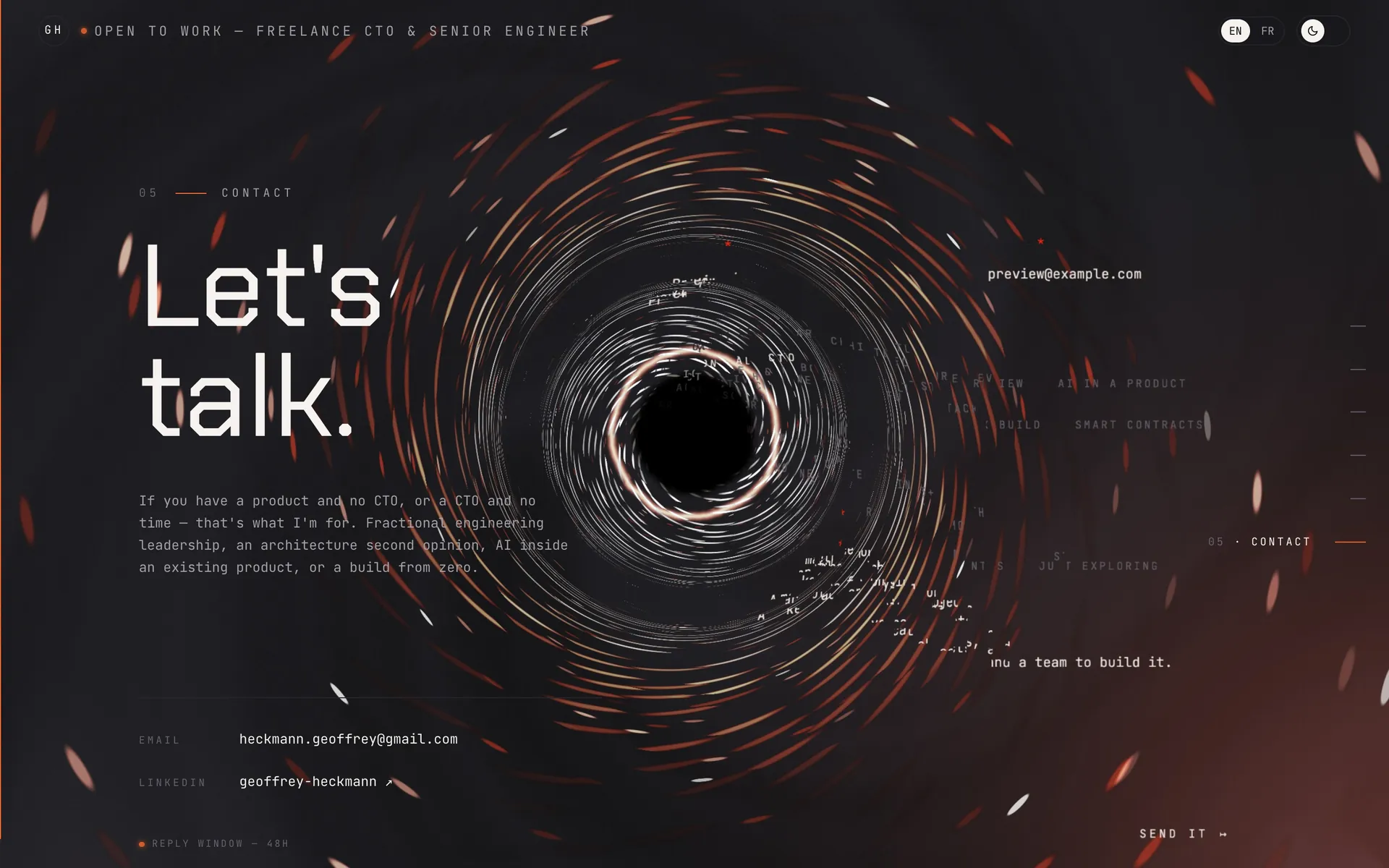
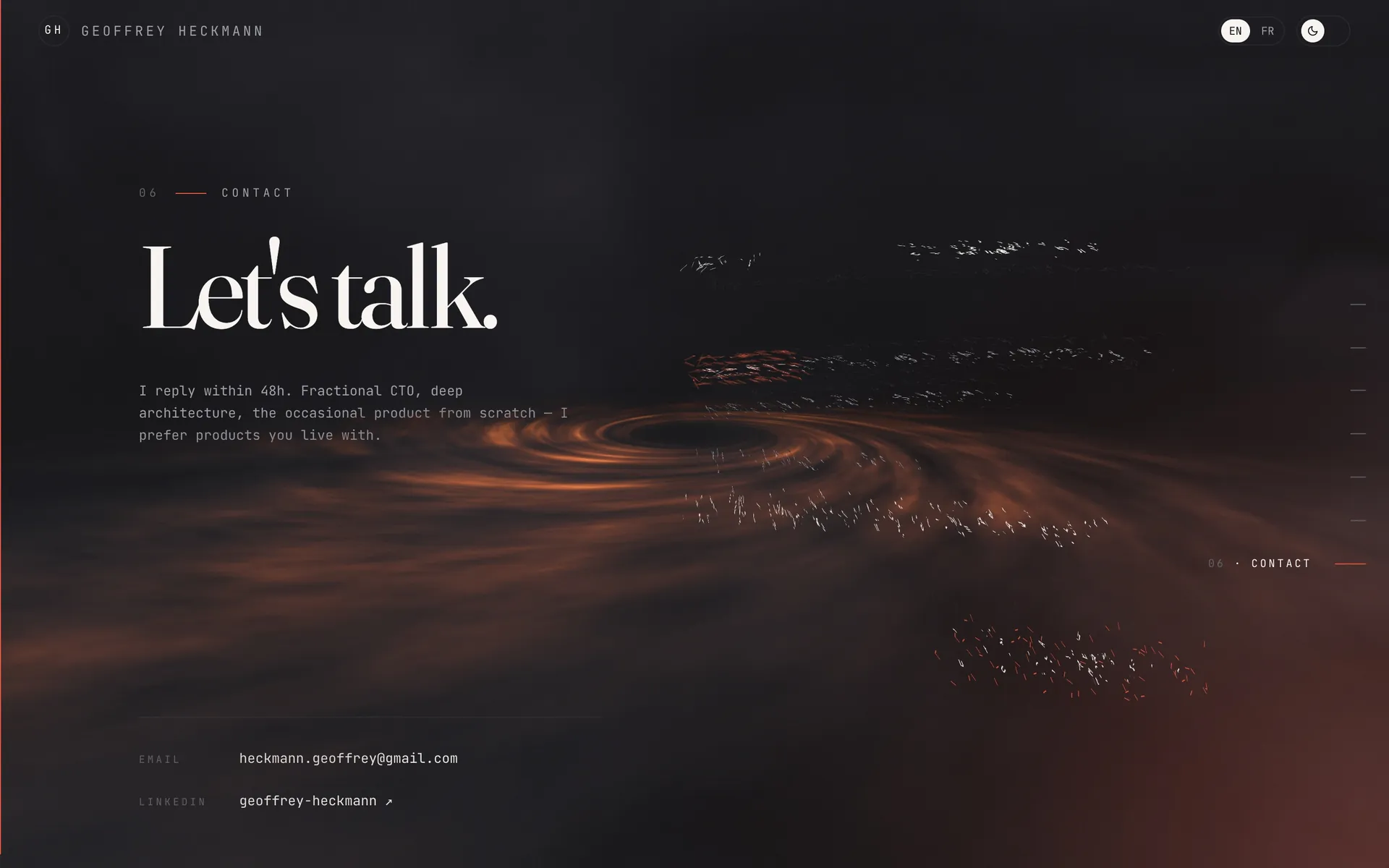
c1b17dcchore: change light theme helix colorsAfterSwallowed by a gravitational lensb8e771efeat(contact): swallow the form into a gravitational lensIn motion
c29870ffeat(home): the work ring shows the work, and the page holds togetherSend the form and it is drawn onto a canvas, cut into tiles and pulled into a gravitational lens. Nine-pixel tiles were confetti. Fourteen keeps whole letters, so a fragment still reads as your words on its way in.
The tiles ride the lens's own spiral, a − C/√r, with the same constant as the marks around them. A tile ends when it crosses the horizon the shader draws, and no timer decides it. Turned along their travel, whole lines came out upside down, so the tiles now stay upright and stretch.
The canvas is one screen tall and sticky inside the section. Both shaders still compose in the section's coordinates, so the picture stayed the same while the buffer on a phone went from 721 × 2855 to 721 × 1601.
Chapter 08Performance45 commits in this chapter
Where the frames went
Each of these costs was invisible in the code and turned up first in a measurement.
Three.js builds a shader program the first time a material is drawn, and reading the program's link log stops the main thread until the driver is done. The canvas now holds its first frame until every program reports itself linked, with a ceiling of three seconds. What remains is the GPU building its pipelines, with the main thread free.
Before
After
At 0.999 the page underneath keeps being drawn.
Before
After
R3F reached in a different order by each canvas.
585KB
Replay and the feedback widget, pulled in by a namespace import. Now a list of named re-exports, fetched after the intro.
Same picture. The shaders compose in the section's frame and map into the canvas last.
Contact
Let's talk.
If you have a product and no CTO, or a CTO and no time — that's what I'm for. Fractional engineering leadership, an architecture second opinion, AI inside an existing product, or a build from zero.